Tuesday, 3 May 2011

WHAT IS NEUTRON STARS AND PULSARS???

Neutron Stars and Pulsars
Overview

Neutron stars are a hyper-dense form of dead star composed almost entirely of neutrons. A sub-class of neutron stars are called pulsars - so-named because, relative to Earth, they emit regular pulses of EM radiation. This page talks about both neutron stars and pulsars.

Neutron Star Formation
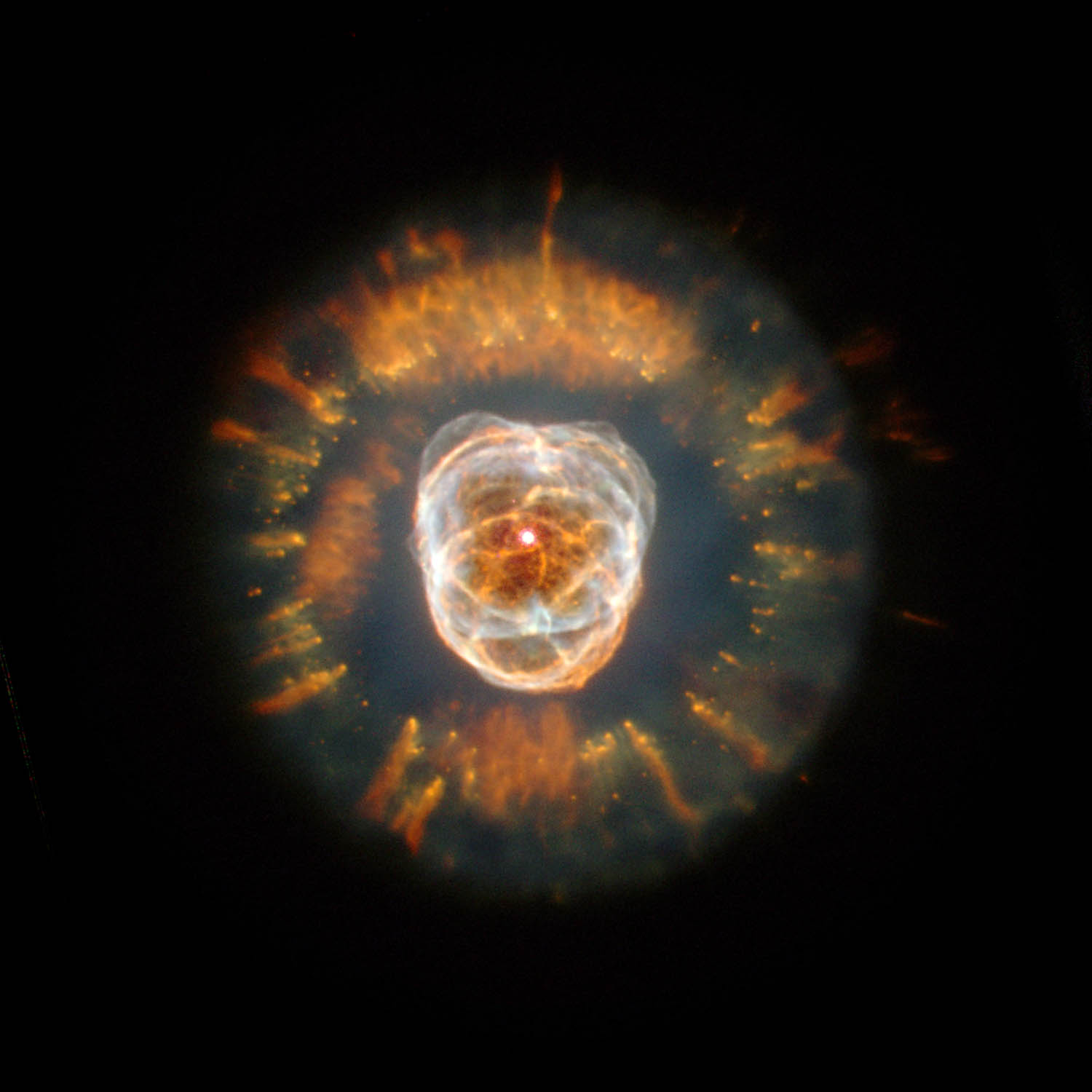
[WHITE DOT IN THE MIDDLE OF THE PHOTO IS NEUTRON STAR]
A neutron star is a star made entirely out of neutrons, as the name suggests. These are the remains of stars that had between 1.4 and 9 times the mass of our sun (solar masses). After a star goes nova, the remaining core collapses while the outer layers are blasted off into space to create a nebula. Gravity shrinks and condenses the core into a sphere about the size of Manhattan (25 km (15 mile) diameter) within a few seconds. A neutron star is so dense that a pinhead's worth of material from one would weigh as much as a supertanker.
Under ordinary classical mechanics, this would not be possible. Atoms are mostly empty space as a result of one of the four fundamental forces: the Electro-Magnetic (EM) Force. This keeps the electrons out of the atom's nucleus. However, the most important principle that comes into play is the Pauli Exclusion Principle and electron degeneracy. This says that no two electrons can occupy the same quantum state. This boils down to no two electrons being able to occupy the same place.
What happens in neutron stars is that the Pauli Exclusion Principle is broken. As more mass is piled on (up to 1.44 solar masses, also called the Chandraskhar Limit), the densities get higher and the electrons are boosted to higher energy levels. Eventually, the required speed for the electrons is greater than that of light in order to support the electron degeneracy.
Once this happens, the star collapses, for the electron degeneracy can no longer support it. In a few brief seconds, the star collapses down to a neutron star, supported by neutron degeneracy, where no two neutrons can occupy the same quantum state. This keeps the neutron star from collapsing further, until its critical mass is reached at about 3 solar masses. Then, the collapse is to a black hole.

Neutron Star Anatomy
Neutron Star SchematicA neutron star's anatomy is very simple, and it has three main layers: A solid core, a "liquid" mantle, and a thin, solid crust. Neutron stars also have a very tiny (a few centimeters - about an inch) atmosphere, but this is not very important in the functioning of the star. Typical sizes for these parts are about 1 km for the crust, and 10 km for the mantle and core combined.
A neutron star also has two axes - a magnetic one and an axis of rotation. Just as Earth's magnetic axis does not run through the geographic poles, a neutron star's axes rarely line up. (Please bare in mind that the schematic at the right is not drawn to scale.)

Pulsars
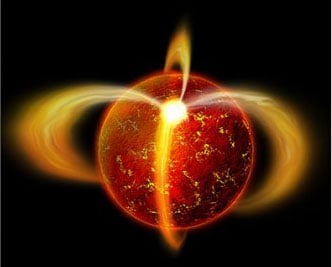
A pulsar is the same object as a neutron star, but with one added feature. A pulsar emits two very high-energy beams into space, concentrated along its magnetic axis (the magnetic field is around one trillion (1,000,000,000,000) times that of the Earth's). The beams are made of material usually stolen from a companion star, and the particles are accelerated to speeds as great as 20% that of light.
Pulsars (and neutron stars) spin very rapidly (as seen from Earth), most at about once every second (the record for the fastest is at 642 rotations per second, and the record for the slowest is one spin every 4.308 seconds). The reason for the rapidity in the spin is due to the law of conservation of angular momentum. This law has such implications that if an object is spinning at a certain speed, then is shrunk but keeps the same mass, it must increase its rotation rate.
For an example of this, take a ball attached to a string and spin it around in such a way that the string wraps around your hand or wrist. You will notice that as the ball comes in closer, it rotates more quickly. Also, once it is wrapped, go the other way so that it unwraps. You will notice that the ball goes more slowly as the string is let out. Another practical example is to watch a figure skater - if they want to spin quickly, they will draw their arms and leg in closer to their body, and in order to slow down, they spread out.
Pulsars will eventually slow down and stop spinning, due to energy lost as it sends off ripples in space (also called gravitational waves, that emanate from all moving massive objects; the waves travel at the speed of light). It will then be seen as an ordinary neutron star because if the beams no longer sweep past Earth we can't see it "pulsing".

WHAT IS NEBULAE??? EXPLAINED...

Nebulae

Originally, the word "nebula" referred to almost any extended astronomical object (other than planets and comets). The word "nebula" comes from the Greek word for "cloud." Before astronomers knew that galaxies were distant collections of stars, galaxies were also called nebulae because of their fuzzy appearance. Today, we reserve the word nebula for extended objects consisting mostly of gas and dust.
Nebulae come in many shapes and sizes, and form in many ways. In some nebulae, stars form out of large clouds of gas and dust; once some stars have formed inside the cloud, their light illuminates the cloud, making it visible to us. These star formation regions are sites of emission and reflection nebulae, like the famous Orion Nebula shown in the picture on the right.
Emission nebulae are clouds of high temperature gas. The atoms in the cloud are energized by ultraviolet light from a nearby star and emit radiation as they fall back into lower energy states (neon lights glow in much the same way). Emission nebulae are usually red, because hydrogen, the most common gas in the universe, most commonly emits red light. Reflection nebulae are clouds of dust that simply reflect the light of a nearby star or stars. Reflection nebulae are usually blue, because blue light scatters more easily. Emission and reflection nebulae are often seen together and are sometimes both referred to as diffuse nebulae. In some nebulae, the star formation regions are so dense and thick that light cannot get through. Not surprisingly, these are called dark nebulae.
Another type of nebula, called a planetary nebula, results from the death of a star. When a star has burned through so much material that it can no longer sustain its own fusion reactions, the star's gravity causes it to collapse. As the star collapses, its interior heats up. The heating of the interior produces a stellar wind that lasts for a few thousand years and blows away the outer layers of the star. When the outer layers have blown away, the remaining core remnant heats the gases, which are now far from the star, and causes them to glow. The resulting "planetary nebulae" (so named because they look like gas giant planets through a telescope) are shells of glowing gas that surround a small core. Astronomers estimate that our galaxy contains about 10,000 planetary nebulae. Planetary nebulae are a common part of the normal stellar life cycle, but they are short-lived, lasting only about 25,000 years.
The life of a star whose mass is greater than 1.4 times the mass of the Sun ends more violently, and leaves behind a different type of nebula called a supernova remnant. When such a star runs out of fuel and collapses, an enormous shock wave sweeps through the star at high speed, blasting away various layers and leaving behind a core called a neutron star and an expanding shell of matter known as a supernova remnant. A supernova's shock wave is much more violent than the stellar wind that marks the end of a low mass star. Near the core of the remnant, electrons emit radiation called "synchrotron radiation" as they spiral toward the neutron star at speeds close to the speed of light. The ultraviolet portion of this radiation can strip electrons off, or "ionize" the outer filaments of the nebula, causing them to glow. In addition, the ejected matter sweeps up surrounding gas and dust as it expands, producing a shock wave that excites and ionizes the gas in the supernova remnant nebula, which is at low density but extremely hot (up to 1,000,000° K!). The most famous supernova remnant is the Crab Nebula in Taurus (M1), shown in the image above. The light of the inner core is from synchrotron radiation, while the outer regions glow in many colors from emission of many gases, including red for hydrogen.

SOME WORLD FAMOUS NEBULAS::::


HORSE HEAD NEBULAE


TRIANGULUM NEBULAE


ORION NEBULA


HST ESCIMO NEBULAE


NEBULAE - OF -BEAUTY


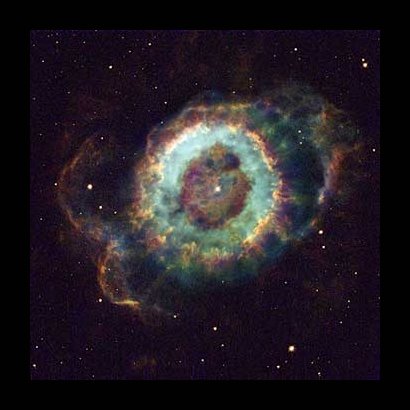
LITTLE GHOST NEBULAE


AND MANY MORE..............................

WHAT IS FIREWALL? EXPLANATION.....

What is a Firewall?

A firewall is a security device that can be a software program or a dedicated network appliance. The main purpose of a firewall is to separate a secure area from a less secure area and to control communications between the two. Firewalls can perform a variety of other functions, but are chiefly responsible for controlling inbound and outbound communications on anything from a single machine to an entire network.

Software Firewalls

Software firewalls, also sometimes called personal firewalls, are designed to run on a single computer. These are most commonly used on home or small office computers that have broadband access, which tend to be left on all the time. A software firewall prevents unwanted access to the computer over a network connection by identifying and preventing communication over risky ports. Computers communicate over many different recognized ports, and the firewall will tend to permit these without prompting or alerting the user. For example, computers access Web pages over port 80 and use port 443 for secure Web communications. A home computer would expect to receive data over these ports. However, a software firewall would probably block any access from the Internet over port 421, over which it does not expect to receive data. Additionally, port 421 has been used by certain Trojans (a type of malware) in the past. Software firewalls can also detect "suspicious" activity from the outside. They can block access to a home computer from an outside address when activity matches certain patterns, like port scanning.
A software firewall also allows certain programs on the user's computer to access the Internet, often by express permission of the user. Windows Update, antivirus software, and Microsoft Word are a few programs that a user might legitimately expect to access the Internet. However, a program called gator.exe that is attempting to access the Internet when it shouldn't be running might be reason for concern, so the user could decline access for this program. This is a useful feature when spyware, adware or some type of malware is suspected.
Some software firewalls also allow configuration of trusted zones. These permit unlimited communication over a wide variety of ports. This type of access may be necessary when a user starts a VPN client to reach a corporate intranet.
One drawback to software firewalls is that they are software running on a personal computer operating system. If the underlying operating system is compromised, then the firewall can be compromised as well. Since many other programs also run on a home computer, malicious software could potentially enter the computer through some other application and compromise the firewall. Software firewalls also rely heavily upon the user making the right decisions. If someone using a software firewall mistakenly gives a keylogger or a Trojan permission to access the Internet, security on that machine is compromised even though there is nothing wrong with the firewall itself.
There are many different brands of software firewalls, each with their own features. Some examples include ZoneAlarm, BlackICE, and Kerio.

Hardware Firewalls

Hardware firewalls are more complex. They also have software components, but run either on a specially engineered network appliance or on an optimized server dedicated to the task of running the firewall. The operating system underlying a hardware firewall is as basic as possible and very difficult to attack. Since no other software runs on these machines, and configuration takes a little more thought than clicking on an "allow" prompt, they are difficult to compromise and tend to be extremely secure.
A hardware firewall is placed between a network, such as a corporation, and a less secure area, such as the Internet. Firewalls also can separate more secure networks from less secure networks, such as one corporate location within a larger corporate structure. Versions of hardware firewalls are available to home users who want stronger protection from potential Internet attacks. There are many different default configurations for these devices - some allow no communications from the outside and must be configured, using rules, others (like those available for the home market) are already configured to block access over risky ports. Rules can be as simple as allowing port 80 traffic to flow through the firewall in both directions, or as complex as only allowing 1433 (SQL server) traffic from a specific IP address outside of the network through the firewall to a single IP address inside the network.
Firewalls are also used for Network Address Translation (NAT). This allows a network to use private IP addresses that are not routed over the Internet. Private IP address schemes allow organizations (or even household networks) to limit the number of publicly routed IP addresses they use, reserving public addresses for Web servers and other externally accessed network equipment. NAT allows administrators to use one public IP address for all of their users to access the Internet - the firewall is "smart" enough to send the requests back to the requesting workstation's internal IP. NAT also allows users inside a network to contact a server using a private IP while users outside the network must contact the same server using an external IP.
In addition to port and IP address rules, firewalls can have a wide variety of functionality. They can also act as caching servers, VPNs, routers, and more. Some examples of hardware firewalls are CheckPoint, Cisco PIX, SonicWall, Contivity from Nortel, and Linksys (for the home market).
Firewalls are vital to network management. Without this control over computer and network access, large networks could not store sensitive data intended for selective retrieval. Firewalls are also very important for home broadband users - without a home version of one of these products, your personal data is at risk.

WHAT IS WHITE NOICE? EXPLANATION.

The best way to explain White Noise is to first look at why it has been given that name. White is used because of the way light works. White light is not an absence of color but is rather a combination of ALL colors. Going along with that same reasoning, White Noise is a combination of ALL frequencies of sound all playing at the same time.
Because white noise is actually a combination of all frequencies it is most likely used as a sound blocker. It is typically used by those in loud city environments or with exceptionally noisy neighbors.
Think of it this way. If you are having a conversation with one person in an empty room you would have no problem understanding that person. Now imagine you are at Sunday family dinner and instead of that one person there are now 20 people around the table all talking at the some time. You would struggle to hear them all so you only pick up one or two voices. Now multiply that times 1,000. Suddenly you have a sea of people all talking at the same time and it is impossible for your brain to “hear" any single voice. Now imagine your noisy neighbor is one of those people. Suddenly you can’t hear them, instead all your brain “hears" is a gentle wave of sound.
When those voices are now frequencies, you get a sound that is a bit like static of a radio.

अजीबोगरीब विमान दुर्घटनाएं

ब्रिटेन की राजधानी लंदन में कल शुक्रवार को ब्रिटिश एयरवेज का एक विमान उतरते समय दुर्घटनाग्रस्त हो गया। इससे दो यात्री घायल हो गए। विमान में कुल 72 यात्री और चालक दल के सदस्य सवार थे। हादसा पूर्वी लंदन के सिटी हवाई अड्डे पर हुआ। चार इंजन वाले विमान के अगले चक्के नहीं खुले जिसके कारण यह फिसलते हुए उतरा। पिछले कुछ दिनों से दुनिया के विभिन्न हिस्सों में अजीबो-गरीब विमान दुर्घटनाएं होती रही हैं। भारत में भी राष्ट्रपति के हेलीकॉप्टर और यात्री विमान के रन-वे पर आमने- सामने आ जाने की घटना हुई थी।

लंदन की दुर्घटना से ठीक एक दिन पहले, गुरुवार को अमेरिका के बफेलो उपनगर ( न्यूयॉर्क राज्य) में रात को एक घर पर छोटा यात्री विमान जा गिरा था जिसमें 49 लोगों की मृत्यु हो गई। मृतकों में एक ऎसी महिला भी शामिल थी जिसके पति का निधन अमेरिका में 2001 में हुए आतंकी हवाई हमलों में हो गया था।


स्विट्ज़रलैण्ड में दो इंजिनों वाला एक छोटा विमान बर्फीली पहाड़ियों में दुर्घटनाग्रस्त हो गया। यह विमान विएना, ऑस्ट्रिया के रास्ते पर था जब इसका इंजिन खराब हो गया और यह बर्फ की एक दीवार से टकरा गया। दुर्घटना में दो लोग मारे गए। 


अमेरिका में ही एक अजीबो-गरीब विमान दुर्घटना हुई थी। इंजिन बंद हो जाने के कारण एक विमान न्यूयॉर्क के निकट हडसन नदी में जा उतरा था। यह विचित्र घटना 15 जनवरी हो हुई जब विमान के दोनों इंजिन पक्षी फंस जाने के कारण अचानक बंद हो गए थे। चालक की सूझबूझ और कौशल से विमान नदी में सकुशल उतर गया था और किसी यात्री को नुकसान नहीं पहुंचा था। लेकिन उसके बाद से हो रही छोटी- मोटी विमान दुर्घटनाओं में लगातार जान-माल का नुकसान हो रहा है। 

TOP 10 WEIRD INCIDENTS FORM INDIA

33 year old marries a dog
Sounds like a new trend? This is a recent tale of a psychotic 33 year old guy who married a stray dog. After killing 2 dogs about 20 years ago, the man believed that marrying a female dog was the only way by which he could make up for his gruesome act.

Lifetime spent amongst the dead for a good night sleep
60-year-old Indian, Mukund Agte heads towards the city’s crematoriums ever night, in order to sleep in peace. While most people wouldn’t dare doing this, Mukund Apte has spent his entire lifetime sleeping admits the dead corpse.
Happily married with a wife, children and grandchildren, no man in the face of this world could ever imagine this neatly dressed, salaried employee spending most of his time in a crematorium.
He visits his family during weekends, and continues to live this horrifying life.

67 fans die of shock over the death of their leader
In a recent air crash incident, Andhra Pradesh chief minister, Y S Rajasekhara Reddy, left this world, leaving all his fans in great remorse. The news of his death shook some of his fans so badly that 67 of them died of shock or by committing suicide.

1 man and 14 wives
One may find it difficult leading a double life, but you will be surprised to know that a 40 year old employee of Air India was living with 14 wives since several years, until he was caught red-handed.
Tushar Waghmare married 14 women in a span of two-and-a-half years. A high profile job with a great salary worked to his advantage in fooling his bride and their family members.
He was incidentally caught when two of his wives accidentally bumped into each other. The interference of the cops revealed that he had married 14 times. After this, who says, “Marriages are made in heaven.”

Sweet eating contest claims 1 life
A laddu eating contest claims the life of a 39 year old catering worker in India. The man was suffering from diabetes, but couldn’t hold his temptation, and gulped down 7 laddus without stopping. This act proved costly as he was declared dead at the hospital footsteps.

Marriage of two trees
You must have heard marriages of animals, but what about trees marriage? In Orissa, a state in India, villagers performed marriage of a banyan tree with a peepal tree. Over 2000 people attended this marriage with colorful possessions and blessings. The trees were garlanded and rituals were chanted, followed by fireworks, dancing and a grand feast for the 2000 attendees. You thought only human beings can pull crowds?

Father at 88
An 88 year old man fathered a son in the Barmer district of Rajasthan (state in India). His wife is 45 years younger than him, and the couple is happy over their achievement. 88 year old, Budhia Ka Tala eats three meals a day and walks around 10 to 35 km on daily basis.

Elephant robs vehicle owners
India is a home to nearly 50%of the wild Asian elephants. A wild elephant in Orissa (state in India) blocks vehicles on the highway, and do not allow them to pass by unless they offer him with food. It forces them to get down of their vehicles, and bribes them like a traffic policeman.

Child dropping ritual
Would you allow someone to drop your few years old child from 20 feet? In a strange ritual performed in a temple in Karnataka, couples without children for a long time come to fulfill their vow that if they were blessed with a child, they will have the newborn child dropped from the village top.
The village priests throw the children from the temple top with few men holding a cloth beneath to catch the dropping child. A slight mishap would mean death however, not a single child has sustained any kind of injury so far.

Wife union to beat up husbands
Husbands beating their wives are often heard. However for a change, in Madanpur, a village in Uttar Pradesh, housewives have formed a union to beat up husbands. In the Madanpur village, most husbands do not work, and indulge themselves in activities like smoking, drinking, gambling etc. The main agenda of this union is to beat up husbands raising their hands on their wives or indulging in any unwanted activities. Sticks and hands are the weapons of operation.

भूतों की फिल्म देख सब पर चढ़ा भूत, करने लगे अजीब हरकतें


इंडोनेशिया में भूतों की फिल्म देखने गया दोस्तों का एक समूह अजीब हरकतें करने लगा।
पिछले हफ्ते बोगोर शहर के एक मॉल से फिल्म देखकर निकला युवाओं का एक समूह कार पार्किंग में पहुंचकर अजीब हरकतें करने लगा।
कुछ युवा चिल्ला रहे थे कुछ रो रहे थे और कई तो जमीन पर लोट पोट हो रहे थे। प्रत्यक्षदर्शियों के मुताबिक यह सब तब शुरु हुआ जब 13 युवाओं का एक समूह डरावनी फिल्म देखकर मॉल से निकला।
ये लोग कार पार्किंग में पहुंचते ही अजीब हरकतें करने लगे और इन्हें देखकर बाकी लोग पर भी इसका असर हो गया। कुछ तो ऐसा बर्ताव कर रहे थे जैसे मिर्गी का दौरा पड़ा हो। मामले की जानकारी मिलते ही सुरक्षाकर्मियों को बुलाया गया लेकिन वो भी कुछ नहीं कर सके।
मजे की बात यह है कि करीब 15 मिनट तक इन युवाओं की हरकतें जारी रहीं और तभी एक व्यक्ति वहां आया। उसने कुछ देर पहले ही नमाज अदा की थी। उस व्यक्ति ने इन सभी युवाओं के सिर को छुआ और फिर वो सामान्य हो गए।
यह युवा भूतों पर बनी फिल्म 13 वेज टू समन डेविल्स (भूतों को बुलाने के 13 तरीके) देखकर हॉल से निकले थे।